The wedding date is the field that runs the season
Dev Uthani Ekadashi falls around Friday, November 20, 2026, and wedding dates open in the days after it. Confirm the exact days against the family's own panchang, because muhurat dates vary by tradition. For skin, hair and dental clinics the wedding calendar brings one kind of enquiry: a person with a fixed date and a number of visits to fit before it.
Everything about that enquiry is set by one field, the wedding date. Capture it at first contact, on the booking form, in the WhatsApp greeting and on the call. Then ask two more questions: how many events the family has (mehendi, sangeet, the wedding, the reception) and who else wants a visit. With those three answers the booking is a plan. Without them it is a slot.
Count backwards, not forwards
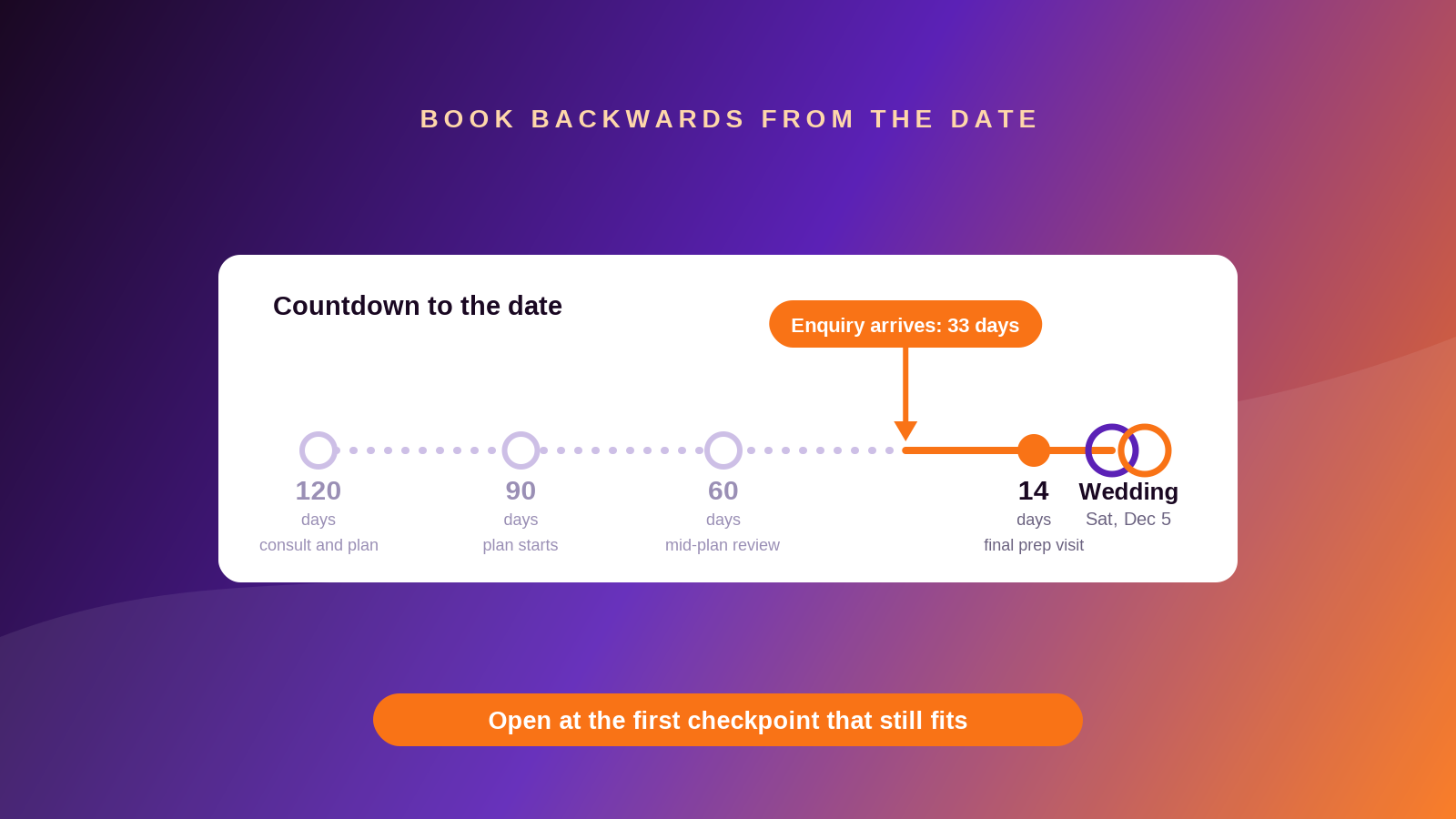
A booking made forwards asks "when are you free?" A booking made backwards asks "what has to be done by when?" Your practitioner sets the clinical plan. The booking skeleton around it is the same for every bride, groom and guest, and your practitioner adjusts each checkpoint to the plan:
- 120 days before: first consult and a written plan.
- 90 days before: the plan starts.
- 60 days before: mid-plan review.
- The cut-off: the last day to start anything new. Your practitioner sets it for each treatment.
- 14 days before: final preparation visit.
- Wedding week: one logistics message and nothing new.
- 7 days after: thank-you message and a review request.
- 30 days after: rebooking offer for maintenance visits.
When the enquiry arrives late
Most enquiries arrive with less time than the skeleton assumes. Say a family messages on Monday, November 2 for a wedding on Saturday, December 5. That is 33 days, so the first checkpoints have passed. Skip them and open at the first one that still fits.
Say it in the first reply: "With 33 days to the wedding, here are the visits that fit, and the first slot is Wednesday." A plan that starts from today's date earns more trust than an apology for the date that has gone, and it turns the enquiry into a booking in one message.
Let the countdown send the follow-ups
Store the wedding date in your CRM and schedule the messages from it. Five messages cover the season:
- Inside a minute of the enquiry: congratulations and one question, "What is the wedding date?" (the 60-second reply rule explains why speed matters here).
- The same day: the visits that fit between today and the date, with the first slot offered.
- 24 hours and 2 hours before each visit: a reminder with the address and the time.
- Wedding week: one logistics message, such as parking and arrival time.
- 7 days after: a thank-you and a review request (the review engine guide has the wording).
Book the party, not the person
A wedding brings a family. Six people want visits before the same date, and six separate threads of messages cost you hours. Offer a block instead: hold two or three adjacent chairs or rooms for a fixed two hours, nominate one coordinator on WhatsApp, and confirm names 48 hours before. The family decides once and you fill a block in a single booking.
Blocks fit best on your quiet weekdays, which keeps your busy hours free for regular clients. The off-peak guide shows how to protect those hours so they fill with the right bookings.
Keep it non-clinical and compliant
This guide covers the booking and follow-up system. Which treatment, how many sessions and what cut-off date belong in a plan are decisions for your practitioner and for the consultation with each person. In your advertising, state the service, the dates and the price, and leave outcome claims out. Photographs of a bride or a groom go on your pages only with their written consent, and your professional council's advertising rules and ASCI guidance apply to every wedding-season post.
Measure the season
Three counts show what the season taught you. Enquiries by lead time (0 to 30 days, 31 to 60, 61 to 90, and 90 or more) show how early families find you. Enquiries to booked consults show how well the first reply works. Source tags show which channel brings families early (keeping the campaign source through WhatsApp covers the setup). If most enquiries arrive inside 45 days, start your reach earlier next year, because the calendar is set by the date and not by your campaign.